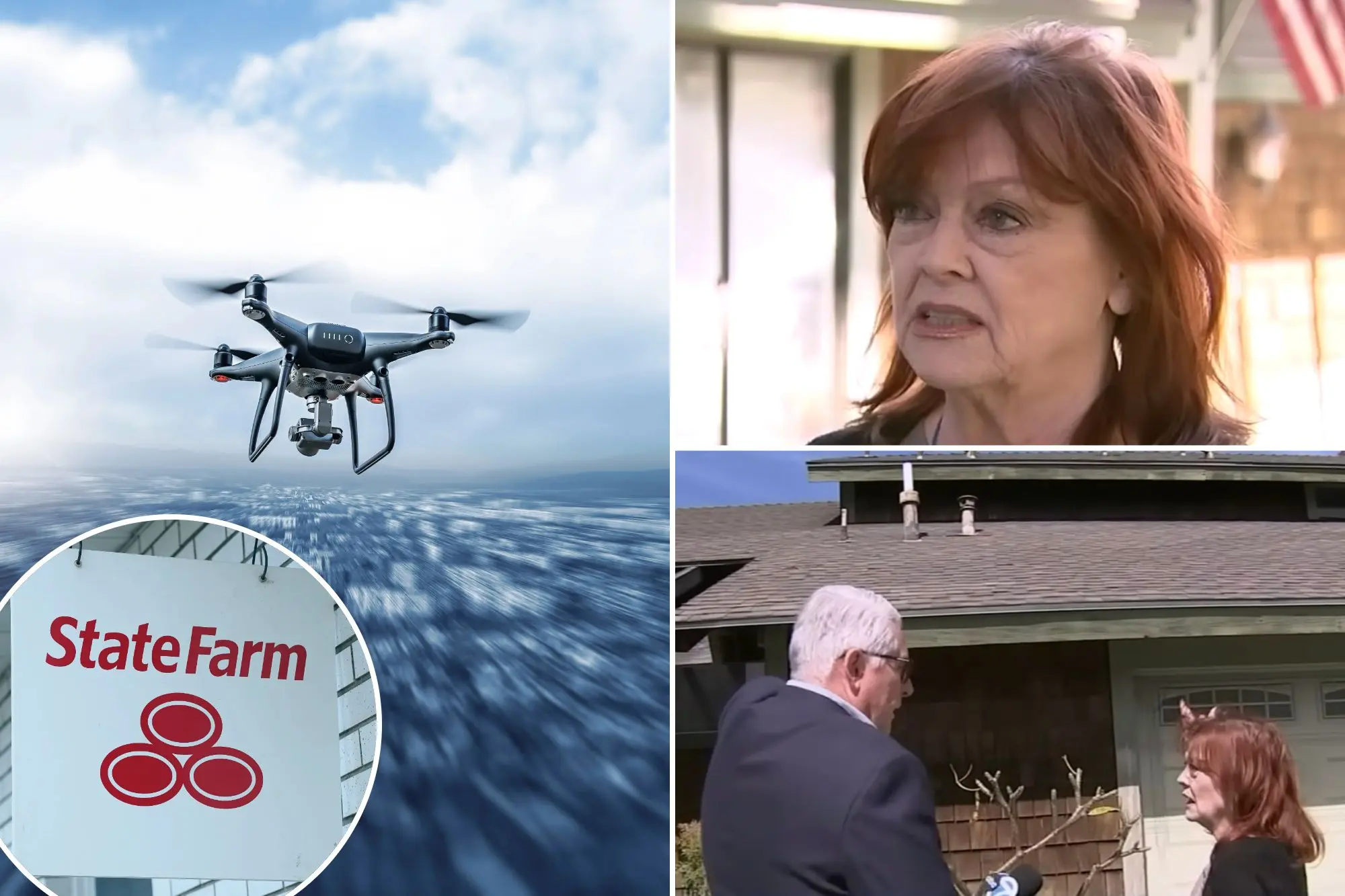

State Farm touts itself as a “good neighbor,” but one California homeowner says the insurer is acting more like a sneaky one.
Linda Bennett, a Santa Ana resident since 1993, was shocked to receive a notice claiming her roof needed replacement—or she risked losing her coverage. The estimated cost? About $20,000.
“My first thought was that it must be a mistake. They’ve got the wrong house because there’s nothing wrong with my roof,” Bennett told ABC7 Eyewitness News.
What made the situation even more baffling, she said, was that no inspector ever set foot on her property. Instead, Bennett believes the insurer assessed her roof remotely, likely using aerial images or drone technology.

A California homeowner says she was hit with a $20,000 repair demand after her insurer allegedly inspected her roof using drones or aerial imagery—without her knowledge.
Her experience highlights a growing trend in the insurance industry, where companies increasingly rely on high-tech tools to evaluate homes remotely. Drones, satellite imagery, and artificial intelligence are now commonly used to assess roofs and other exterior features when deciding whether to renew policies.
The notice from State Farm stated that the roof must be replaced with approved materials. Bennett, however, says the demand doesn’t add up, insisting her roof shows no signs of leaks or damage.
“There’s no water damage to my house, inside or out. My roof has not leaked at all,” she said.


Bennett says she has never experienced leaks or damage and was shocked that no inspector ever visited her home, leading her to believe the insurer assessed the roof remotely.
“A lot of this technology is being marketed to insurers with the promise that using drones or AI tools will help them identify good risks and weed out bad ones. That’s exactly what insurers are doing,” said Amy Bach of consumer advocacy group United Policyholders.
However, Bach warned that these systems are far from foolproof.
“We’re still seeing cases where drones and AI draw incorrect conclusions about what they detect,” she said.
Bennett said the process left her uneasy, especially since she had no prior knowledge that her home was being reviewed.


Consumer advocates warn that new technology can sometimes misinterpret a property’s condition, potentially leading insurers to drop longtime policyholders based on inaccurate data.
Insurance experts say the use of drones, satellites, and AI-powered monitoring is expanding rapidly, as companies look for ways to reduce exposure to costly claims—especially in the wake of California’s wildfires and other disasters.
“We’re seeing an overreaction by insurance companies to data they’re now getting through new technology,” said Amy Bach of United Policyholders. “Homes that have been insured for decades are being dropped, even though nothing has changed on the homeowner’s part.”
State Farm confirmed that aerial imagery is just one of several tools it may use when reviewing a property.
“To assess roof condition, we may use a mix of tools, including aerial images from manned aircraft or satellites and, in some cases, an on-site inspection,” the company said in a statement.


State Farm reiterated that homeowners who believe an evaluation is incorrect should contact their agent with supporting documentation.
“If customers believe a review doesn’t reflect the roof’s current condition, or repairs have already been completed, they should reach out to their local State Farm agent. Recent photos, a roofing invoice, or an inspection report can be helpful in these discussions,” the company said.
For Bennett, however, time is running out. She has until May 1 to resolve the issue and says she has struggled to find another insurer willing to cover her home.
“You have to decide what kind of roof you want, this or that, or what’s in compliance with them,” she said. “They require certain paperwork. I just feel stuck.”


